|
| poppies in a field in Amstetten |
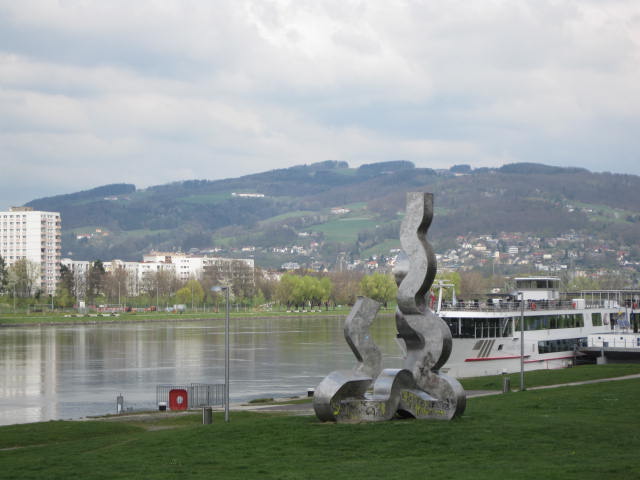
I know that I will have many memories of my time in Austria. One of the fondest, and yet more mundane, will be of my daily walk/run along the Ybbs. I have finally brought a camera along and will share with you some of what I see every day:

Doubtless, these photos (and, by extension, this blog) will help me remember much of what has happened this year. It's a curious thing, memory. There have been countless studies done on how people retain memories, a very recent one picked up as a topic on NPR's
Talk of the Nation about our earliest memories: why do young children remember things from very early in life, yet as we age, we forget most of what happened to us before the age of four?
Here is the article that accompanied the program on NPR's website.

Since I can get streaming radio on my computer, some of the copious free time I've recently been blessed to have (seeing as it is now summer vacation for me) has been eaten up by my "catching up" on certain things I miss from America. Including, yes, NPR programming.
The show (as well as the transcript) was quite interesting. The expert brought in said that several memories of early life are attached to emotions. If a person experiences a strong emotion during an event, he or she is more likely to remember not only the event, but more details of the event as well. The most powerful emotions are often fear or anger (dangerous situations and arguments are easier to remember than calm or happy situations) as are shocking or new situations. This made me think about my own earliest memories, one that involves the German language, actually.
I remember as a very young child watching news footage of the Berlin Wall being torn down. I was two, almost three, most likely watching the evening news with my parents. I remember the television we had at the time, an old analog dial set that fit snugly within the shelves of our entertainment system, next to my dad's record player and enormous white speakers. It's been a tradition in my family ever since I can remember to watch the news together at 6pm, huddled around the TV in the living room. And before the advent of cable, this was even easier - fewer channels, and less crap to watch. We did eventually get cable, but that was long after I had started elementary school.
 |
| calf put out to pasture |
I remember images bursting onto the screen, the ones that have become stock footage now - people in the dark mounting the wall, taking sledge hammers to the side, East Germans walking triumphantly past guards, waving at the cameras. My parents sat in shock, probably in disbelief. Watching these images, they knew that the Cold War - and ideological terror of the "other" that had existed since before they we both born, mounted in bomb scares, fears of traveling abroad, the destruction of "the American way of life," that had urged hate and conspiracy and espionage - would soon be over.
And it happened overnight, quickly and without warning. That is why my parents sat shocked. I'm sure they discussed it afterward. This would change the way they viewed the world. the way millions of people viewed the world. And this was the era before the 24-hour news network, before streaming video and internet and chat rooms and information all the time, anywhere and everywhere at the click of a mouse. They could read more in the papers the next morning, watch the news again the next evening, when the reporters had submitted new information. They had to wait - they may have waited on tenterhooks.
 |
| cow (mommy) |
Although I, a child, could not contribute meaningfully to a conversation about international affairs, the collective breath of the world expelling what it had been holding back for over 40 years, I understood that something important had happened. Berlin. I remembered the name. It held weight for me. When I was older, old enough to look up things in an encyclopedia (we had a set in the house, circa 1992) I discovered many things (now all outdated) about Berlin: it was a city, divided, the new capital of a reunited Germany.
I feel that this experience grounded my interest in the German language, in Germany, in Berlin. I wanted to see for myself what sort of a city this was, what happened there, how people lived. It seemed like a city with a fantastic history, a place making history, alive, being shaped, becoming renewed. As a teenager, exposure to the stories of Christopher Isherwood and Cabaret and pop culture like Nena, propelled my interest in learning German. Of course, these were not my only reasons, but more to add to my list. I had already taken French, and wished to continue. To pick up a second foreign language, I had the choice between German or Spanish, and (as I've heard from many other students of German) the odds were against Spanish, mainly because it was seen as the lesser of all the offered foreign languages (all the dumb kids took it). This is, of course, unfair to the Spanish language, beautiful in its own way; I have grown fond of Spanish after having learned it - given it a chance.
 |
| preparations for Sonnenwende (Midsummer's Night) |
German, anyway, and French, were my chosen university majors. These choices allowed me to study abroad. And where did I choose? Berlin, of course. I was not disappointed. I fell in love with the city a bit, I think. I still have fond memories of my time there. The city was alive, changing, making history. Vibrant. Charming. Magnificent. A big city, but not too big, like London, or too seedy, like L.A. Plenty of history, but still plenty of future, too.
I point to this earliest of memories, watching the news with my parents as a toddler, to be part of the reason I am here now, in Austria, continuing to learn German. Continuing to be fascinated by the German language, by the history and culture of Central Europe. There are so many things that could be said about how destinies are shaped. Some say it is purely the past which determines the future. Others say the past is only and example to be learned from. I would argue that memories, being an exquisite form, a representation of the past controlled and controllable by the possessor of said memory, are the greatest tool in shaping one's destiny, if past and future being in equal parts relevant help us determine who we are. Or who we shall become.
 |
| train tracks |